February, 2026
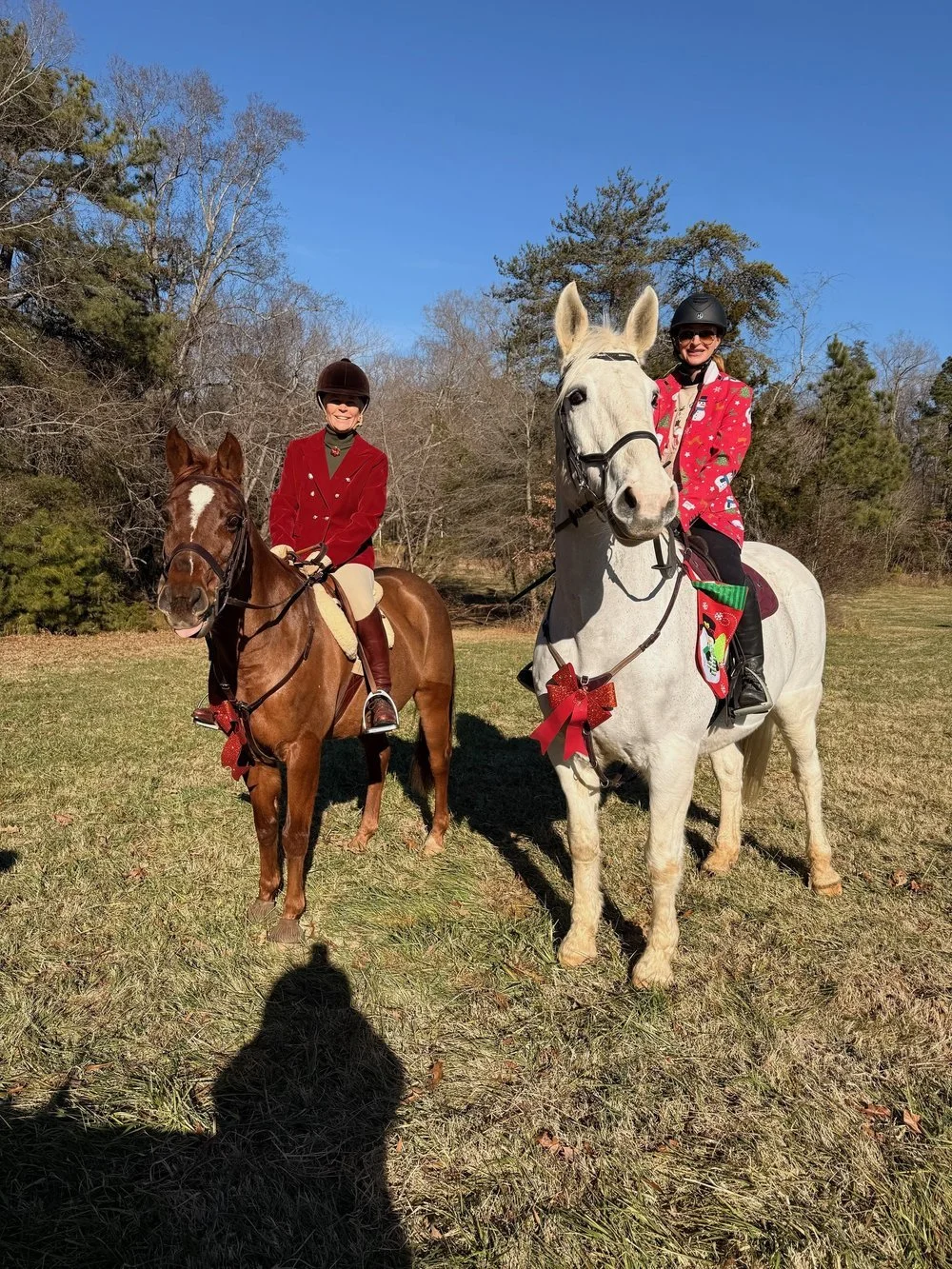
EB Stutts on Hamipton and guest Summer Gentry aboard Big Jon in full holiday turnout at the Stocking Stuffer Ride.

President's Report
-Col. Frank Huber
I, along with the Board of Directors, wish you a happy, healthy and enjoyable New Year. Despite the difficult weather we have been having in central Virginia, there continue to be many things occurring to improve your experience at the Goochland campus. We also continue to plan for a “Spring Cleaning & Maintenance Day”, hopefully in April – please watch your email and come and assist in any way you wish. It promises to be a fun day where we can “spruce up” the clubhouse after the beating Mother Nature has delivered this winter.
Many improvements and safety enhancements were made to our beloved clubhouse during 2025 so it can continue to be a wonderful place where we can gather and tell many tales of our foxhunting exploits (all true of course.)
Early in the year Tom Phillips very generously softened the light in the clubhouse with new window shades. He also greatly improved the atmosphere during events with extensive acoustic paneling in the main hall. It is now much easier to have a conversation during our social events. Thank you, Tom.
Last year also closed out the use of our underground fuel storage tanks, both propane and fuel oil. The result is cleaner heating and cooling along with the dual savings of expenditures with John Harrison making multiple trips to relocate the fuel oil to the Cumberland campus and replacement of the oil-fired furnace with a cleaner HVAC unit using electricity. These changes are expected to result in reduced heating and cooling costs.
Moving to the exterior of the building, professional arborists treated several of the oak trees that surround the clubhouse with extensive pruning of dead limbs and treatment for insects that damage the trees, and a few dead trees were removed. Surface drainage was improved with the installation of water bars leading to the cross-country field. These landscaping efforts have led to a great aesthetic improvement around the clubhouse.
We also owe a tremendous debt of gratitude to the Deep Run Horse Show Association which made a substantial investment in a very antiquated and failing water system. The Association built a new above-ground pump house, surge tanks, valves, and water regulating system. With this new advanced system, the show grounds, clubhouse and Pinecrest all have clean, reliable water for the first time in many years. If you see a member of the DRHSA please thank them for their tremendous contribution to our Goochland campus.
Thank you again to the members who have contributed to our annual Club contribution campaign. Your generosity has enabled us to invest prudently, ensuring that we have quality hunting and facilities that are expected from one of the oldest fox hunts in the United States.
We still have a few more weeks of hunting left in the season, hopefully the weather and ground will improve soon, and we will get some final meets in before the season closes.who have not yet made their commitment for the current Club year, I encourage you to reflect on all the activities that our Club supports and the necessity of properly funding them. Whether or not you are able to ride this season, our hounds and horses still require care and feeding, equipment must be kept in working order, and salaries, taxes, and utilities must be paid. Your financial support is essential to maintaining the level of excellence for which our club is known.
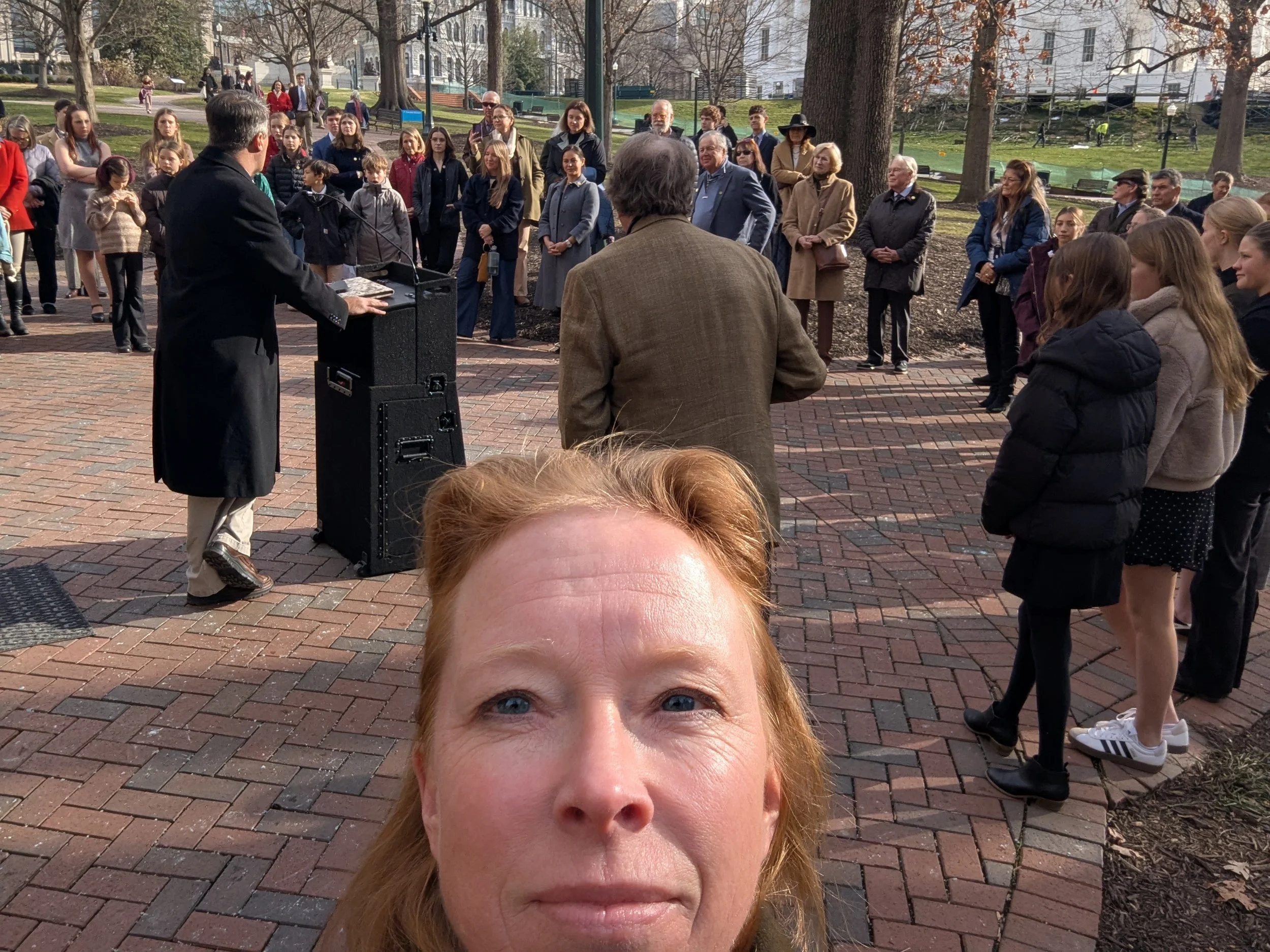
Caroline Eichler, MFH, captures the scene at the legislature
Your Voice Matters - DRHC and DRHPC Legislative Day
- Caroline Eichler, MFH
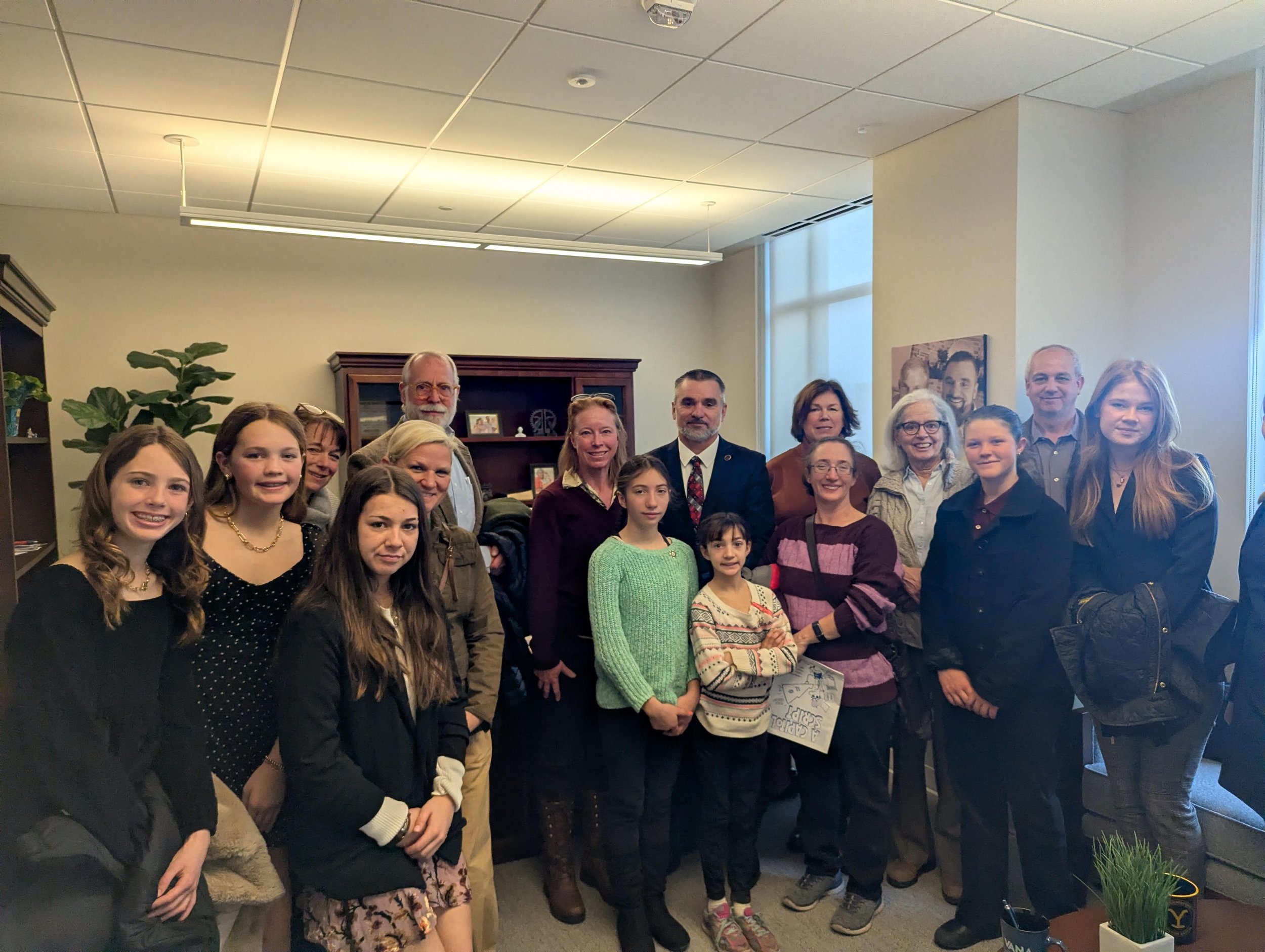
Pony Club and Club members support fox hunting at the Capitol
Deep Run Hunt Club and the Deep Run Hunt Pony Club joined forces in late January for our annual Legislative Day at the General Assembly. This year there are several bills that will negatively impact hunting with hounds in the Commonwealth. It is critical that we stay vigilant as even small legislative or regulatory changes that may seem inconsequential have a large impact on our ability to safely manage and hunt our territory - from dog trespass and increased criminal penalties, to challenging permit requirements and poorly worded bill drafts.
Sharing our concerns and priorities with our legislators is an important part of the process. After meeting with the delegates (and Senator!) representing our hunt territory, we joined with several other foxhunt clubs from across the Commonwealth in front of the Capital to hear remarks from other delegates from across the Commonwealth, as well as Ryan Brown, the Executive Director of the Department of Wildlife Resources. Pony Club representatives from Rappahannock and Keswick Hunt Clubs also spoke.
MFHA President Penny Denegre, MFH, and the new MFHA executive director Linda Taliaferro attended the gathering. Our youth is the future of our sport and our Club; it is thrilling to see their participation and support. At the time of this writing, the General Assembly is still meeting and voting - an update will be provided on legislative impacts following the session.
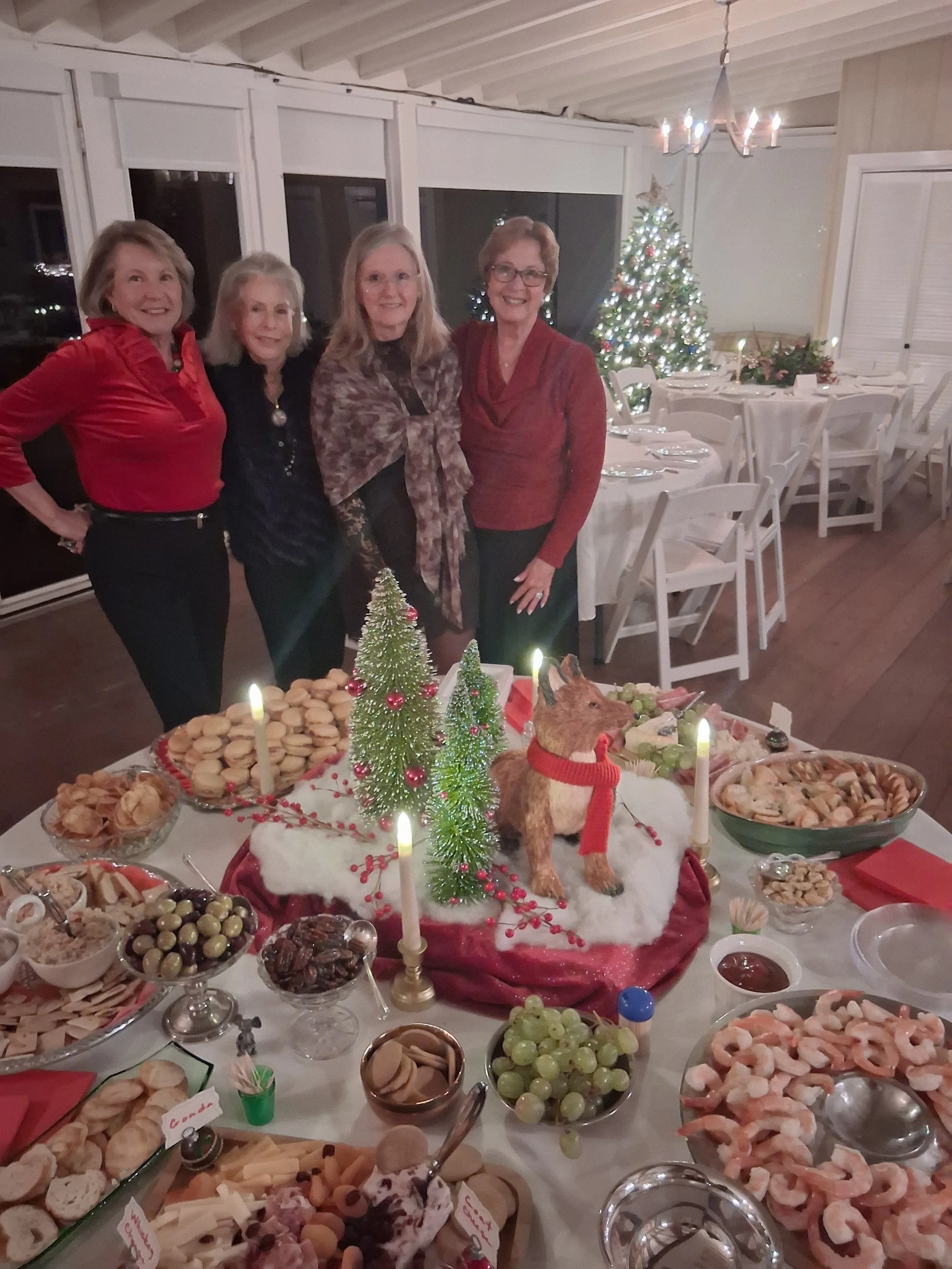
Hostesses Wendy Woods, Jonnah Barber, Joy Robinson, and Pam Stinson welcome guests at the Candlelight Supper
The Social Scene
-Stacy Wimmer
Greetings from the Entertainment Committee - we are excited for the 2026 social calendar; there is something for everybody!
Starting out in March, we will feature Closing Meet events, which include a Low Country Boil, Casino Night, and Silent Auction. Throughout the year, we will be hosting our Annual Kentucky Derby Party in May, Foxy Fridays on the second Friday most months, an evening movie on the lawn, Hampton's Party, the BBQ and Blues dinner, and our Fall Festival with a Silent Auction and a Bingo Night at the clubhouse as the weather turns cooler.
Our third annual Holiday Market will occur in November in time for the Holiday Season, and of course our Candlelight Supper in December to ring in the holidays! Scattered in between, we will be working on Happy Hours With The Hounds and wine tastings.
If you are able to volunteer your time to help with these events, we look forward to welcoming you to the Entertainment Committee - more makes the merrier!
Christmas “Stocking Stuffer” Ride
-by Bennett Camp-Crowder
The tinsel was flowing and the reindeer horns were firmly affixed between velvet ears in December at DRHC. Ninety-five riders and their mounts showed up on a gorgeous December day in full holiday regalia to compete in our “Stocking Stuffer” team ride.
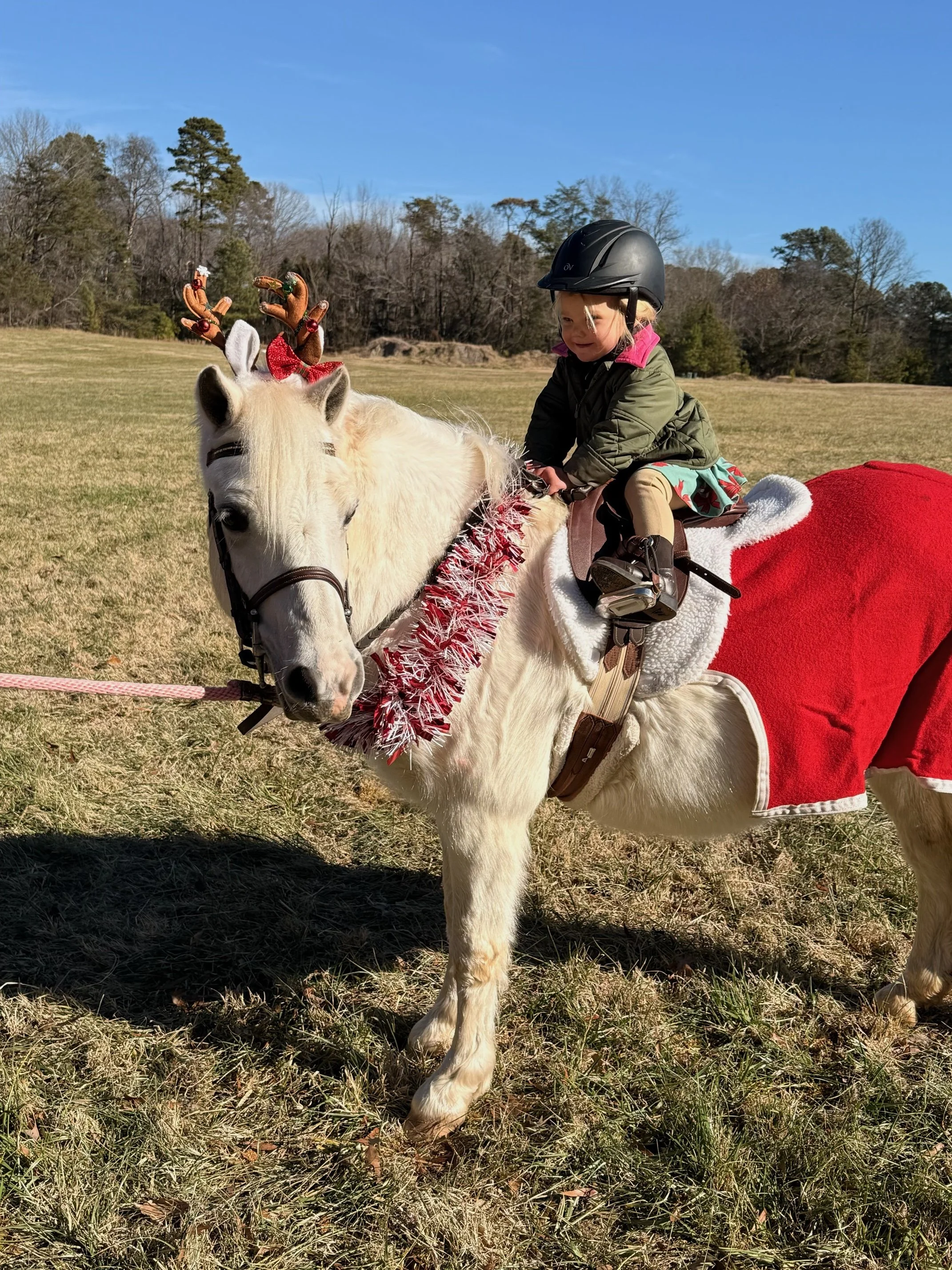
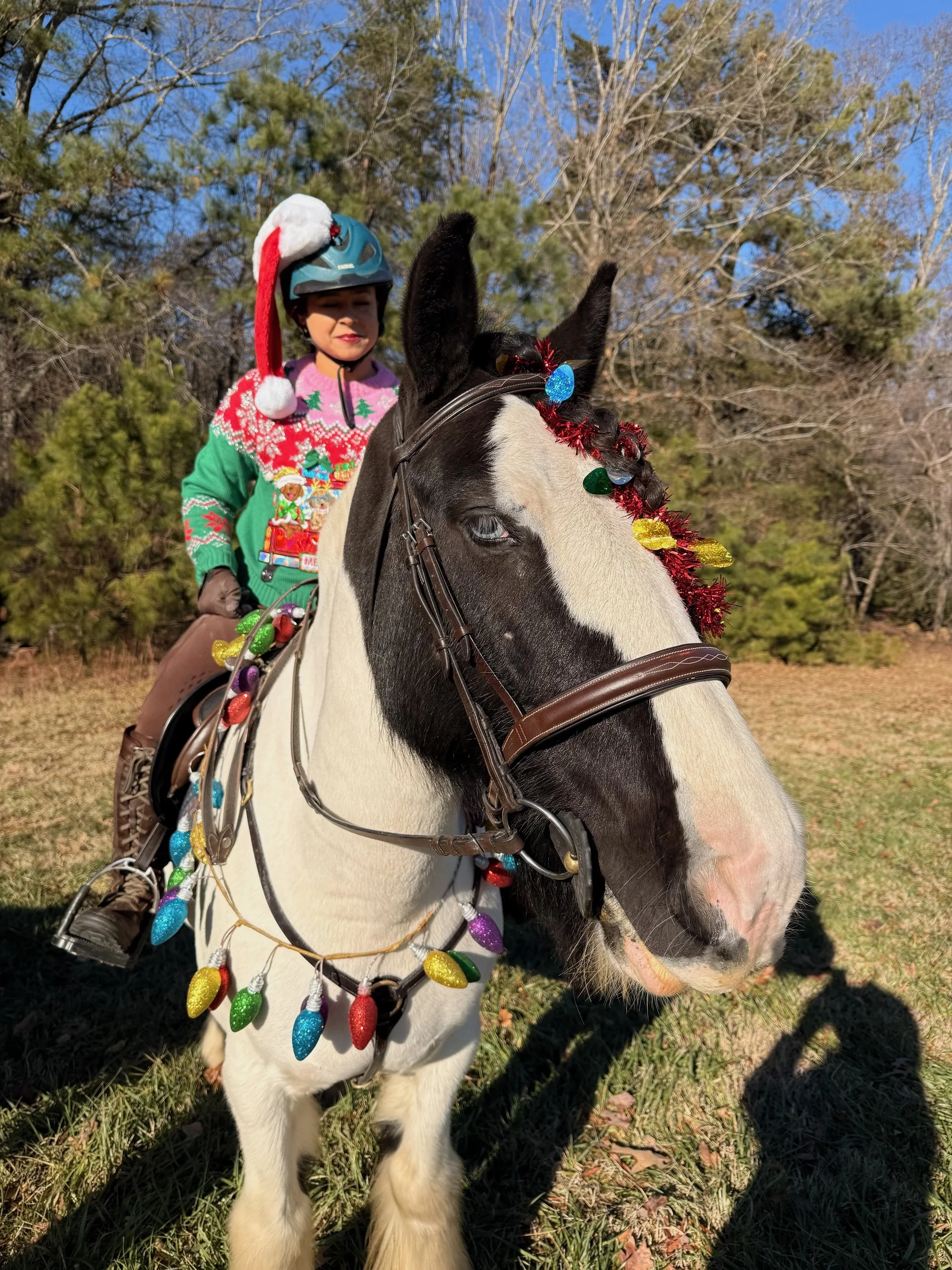
The competition wound around miles of trails in the Deep Run Woods, where riders stopped at tables for goodies and holiday treats. Afterward, all gathered ‘round the fire for cocoa and laughter.
Organizer Gretel Mangigian prepared a groaning board of delectable treats. Kudos to new member Betsy Kapsak who refurbished trails and set the course!
Our Club’s former President, Wendy Woods, and her husband, Ron Payne, also a former President, found this 1987 history of the Club interesting. We hope you do, too!
A Brief History of Deep Run Hunt Club-1887 to 1987
by Oliver Jackson Sands, Jr.
“Of all the recreations with which moral man is blessed,
Go where he will, fox hunting still is pleasantest and best.”
The year was 1887. Although a few traces remained of the destruction that Richmond had suffered during the War, there were many changes in the way of life, for an era had gone with the wind.
Richmond city limits stretched to Lombardy Street, with the Fair Grounds in Monroe Park just beyond. During the year, a new railroad station was built, where horse-drawn cars gave away to electric ones with the announcement that there would be "no danger, no noise, no smoke," and Deep Run Hunt Club was formed. 1887 was a very good year. And that is why this year we are celebrating the 100th anniversary of that club.
Fox hunting came early to Virginia. Colonial records often referred to it, and George Washington loved the sport. It was only after The War had changed plantation life to a more urban society that it became necessary to organize a club to carry it on. And so it was that a sporting Irishman named Blacker, his two Britiah sons-in-law, the Handcock brothers, the British consul Mr. Brine, along with several Richmond friends, decided to hunt together, and thereupon organize the Deep Run Hunt Club. The name “Deep Run” was taken from a stream of that name which runs through the western part of Henrico County into Tuckahoe Creek. Captain Hacksaw was president, William Rueger, whose restaurant was the downtown meeting place for the group was treasurer, and Major Handcock was MFH.
Hounds were kept at Mr. Blackers's home "Chantilly," which was 3 miles west of the city on the Deep Run Turnpike now called Broad Street, which ran to the Gayton Coal mines in Goochland County. Meets were twice a week on Wednesday and Saturday. Usually the hunt was a "drag," but bye days offered the chance to hunt a fox, and later it became customary to hunt a deer on Christmas morning. The Club was an immediate success, and was shortly forced to move to more commodious quarters.
The first move was to Major Handcock's home on Staples Mill Road, as he had been called home to England, and this was not satisfactory, and so in 1896 at the invitation of Major Ginter, it was moved to “Rosedale Lodge” near the Hill Monument in Ginter Park. This was an attractive clubhouse, and besides there were stables for 40 horses, a shed for bicycles, a mile race track, and a nine-hole golf course – one of the first in Virginia. Race meetings were held in spring and fall, and extensively covered in the newspapers as they were the most important sporting events of that time. The fourth annual meeting was headlined "Races a Success.” The attendance was not large, but The Fashionable were out in force.
Richmond had grown to 85,000 in 1900 and the Club membership was 218. Twice that season hounds met at the Lee Monument “on the edge of town,” and there were constant references in the press of the “prowess of the lady writers on their spirited thoroughbreds.” That year the club was recognized by the National Steeplechase and Hunt Association, then the governing body of fox hunting, and in 1904 the Confederate gray collar was worn for the first time. Later that winter, the first Hunt Ball was held, and 30 members attended in evening scarlet and knee britches.
Ginter Park was developing rapidly, and hunting space became scarcer and scarcer. Therefore, in 1910, the Club accepted the invitation of the newly formed Country Club of Virginia to merge with it. Jumps were built along the Three Chopt Road and Saint Andrews Lane and a steeplechase course laid out down the River Road toward Westham Station. Hounds met, races and horse shows were held before the beautiful colonial clubhouse of the Country Club. However, the marriage was not a happy one for two sports were too dissimilar. As a result, with the advent of World War I, it came to an end when hunting ceased and hounds were dispersed. Nonetheless, the memory lingered on, and when the Country Club developed its James River course, it again asked the Hunt Club to merge with it. This time the invitation was politely refused.
There was, however, fire in the embers, and in 1923, when the war had ended, Eugene B. Sydnor, ably assisted by Thomas E. Gay, James M. Ball, Jr., John Hughes, Thomas E. Hughes, and W.B. Sydnor sparked the Club's Renaissance.
An old farmhouse on Broad Street belonging to the RF&P Railroad was turned into a clubhouse, and soon hunting was resumed under the Mastership of Ormand Young. He was in turn succeeded by Dr. Sinton, James G. Earnest, Edmund Preston, John H. Hughes, and Asa Shield, all great sportsman who left the imprint of their personalities and character on the Club.
This was a businessman's hunt. "Drags" were held every Saturday afternoon and a fox hunt whenever one could be arranged. The pace was fast and the fences big for it was a hard riding group who hunted a wide country from “Westover” in Charles City County to “Whippenock” in Dinwiddie and “Hawkwood” in Louisa. The New Year's Day hunt and breakfast with the Robert Daniels at “Brandon” was an annual fixture, as was the Washington’s Birthday hunt at “Millwood” near Aylett.
Horse shows were held on Memorial Day weekends, and lasted two or three days depending on the number of entries. The crowds always thrilled when the announcer called, “Let ‘em rack." Race meetings began again in 1928 and were held at “Curle's Neck” on turf, hallowed by the memory of the mighty “Uhlan” and the incomparable “Harvester.” The best steeplechasers in America raced there and the race breakfasts at the Commonwealth Club when Rush served the first mint juleps of the season were unequaled anywhere. The Hunt Ball ended the day’s activities. In 1974, Deep Run gave up the race meeting, which was moved to “Strawberry Hill” in 1946, but racing continued under the guidance of the Atlantic Rural Exposition, and in 1981 the Historic Richmond Foundation joined the State Fair in sponsoring "Richmond's Foremost Sporting Event." The Club has continued always its interest and support of racing.
Richmond was marching relentlessly forward and all through the west end, streets were being paved and houses built. No longer were there trails through the Skipwith fields and the Westham Woods. The time had come when the Club had once again to move to more open country. The search began. After looking at all directions, even south of the James in the “Winston country,” in 1932 the Club purchased 142 acres in Goochland county known as the Keeton Farm. There was a frame house and barn on the property, but no road into them from the highway. However, before anything could be done, World War II began, and many members of the Club went off to service.
This time, hunting did not have to stop but was kept alive by a dedicated a few among them were Dr. Shield, MFH, Gina Rawls, who hunted the hounds, Jim Wheat, Jim Tucker, Walter and Willson Craigie, and Bruce McKaig to name but a few. When the members returned from war, hounds were moved to Dr. Shield's first and then in 1948 to the Club where kennels and a stable had been built.
Jimmy Hughes and Jack Sands then became Joint Masters, and immediately abandoned drag hunting for fox hunting. Hounds were badly needed, and they searched the State to find new ones with which to start a new pack and establish a breeding program. They alternated as Master and Huntsman, and under their direction to seriously open the country with conferences with land owners to whom the sport was new. All of this was ably continued by George Cole Scott, Jr., who became Master when Dr. Hughes retired and Col. Sands was recalled to duty and learned to follow stag in France in what he called "Hunting to Music, France’s Royal Sport."
Scott constructed much better kennels as the pack improved and the old farmhouse was made into a livable home for the professional Huntsman and his family. A new clubhouse was designed by Marcellus Wright and built on the hill overlooking the hunter trials course. Then came the construction of a show ring in the front meadow with a grandstand, judge’s stand, and stalling for 100 horses. The membership was growing, and it soon became necessary to enlarge the clubhouse. At the same time, a swimming pool and two tennis courts were built to courage "off-season" activities.
Major Murray Bayliss, who retired from the British army, followed Scott, and worked tirelessly with the younger members. He was able to devote more time to them when he was joined by Richard Reynolds as Joint Master. The 1960 season open with James A. Saunders as Joint Masters with Reynolds, but a severe accident caused his retirement, and Bayliss was urged to return. Kennon Perrin became Master in 1967 and showed excellent sport until his resignation five years later when he was succeeded by Fairfax Randolph and Mrs. Thomas Coates, the first lady to be so honored by the Club. This season another lovely lady will join the hunt staff when Mrs. Mary Robertson joints Coleman Perrin and Fred Reed, who have served with distinction since 1980, as Joint Masters. The professional staff is Timothy Kneipp, Huntsman, and Tony Leahy, Whipper-in.
After cubbing in the early fall, Opening Meet will be in late October with a stirrup cup at “Full Stream Farm,” home of Mrs. Asa Shield. On Thanksgiving day there is a special service at St. Mary's Episcopal Church followed by a hunt and afterwards a breakfast at the Club. Collins Denny is currently president of the club and Mrs. Sue Hagan, the treasurer and club manager. Her professionalism and personal charm have made her indispensable to the operation and happiness of 500 members of the Club.
Only the Piedmont Foxhounds are older than the Deep Run in Virginia and few clubs anywhere have enjoyed a wider range of activities. There are tennis tournaments and swimming meets in summer, barbecues and oyster roasts in their proper season. Polo was first tried by Spencer Carter, John Stewart Bryan, and others at “Rosedale Lodge,” and for a while at flourished in Goochland under Bayliss, Edgar Staples, and Raymond Firestone, Jr. Trap shooting and skeet had their day. Horse shows for seniors, horse shows for juniors, and pony clubs are being thoroughly enjoyed. The Fox Hill Beagles moved into a new kennel near the horse show barns, and with Miss Virginia Heyward as Master are be becoming increasingly popular when they hunt on Sunday afternoons.
But after all is said and done, fox hunting remains the reason for the Deep Run Hunt Club. From November to March hunting horns are blowing across the fields and through the woods of Goochland. Fox hunting can exist only so long as the land owners want it to, for fox hunting belongs to the country and those who live there. Here a tradition runs deep and the sporting instinct is strong. During the past few years, a number of members of the Club have moved to Goochland. Formerly, the majority of members lived in the city and stabled horses at the Club or nearby, and hacked to the place of meeting. Today, most members have available to them horse vans or trailers, and there is no impediment to holding meet anywhere in the Club territory. This has materially widened the Club’s hunting area and at the same time lessened the camaraderie that existed at the clubhouse following a hunt, when the riders forgathered and the tales were told and the story spun. Here memories were created.
It is a grand sight to see young entry in the Field, and we are fortunate that more and more are hunting today, for it is only through them that we can continue the sport. As Mr. Jorrocks, creation of the pen of Robert Surtees said, "it is clearly the duty of every man to subscribe to a pack of hounds, even if he has to borrow the money.”
So, in the words of an old hunting song by Adam Lindsey Gordon:
"Then fill your glass, and drain it too, with all your heart and soul,
to the best of sports - the Fox Hunt, the Fair Ones, and the bowl."